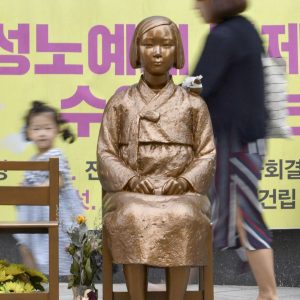
“The Truth about Japan-Korea Annexation” Release on Google Drive

October 1, 2021
Sumiyo Egawa
The President of AJCN


I am delighted to announce that everyone can access the e-book (PDF), “The Truth about Japan-Korea Annexation: South Korea’s Groundless Accusations & Harassments of Japan.”  The e-book has been uploaded on Google Drive and is a Free Download.

The e-book is the English version of Masanori Mizuma’s book, "The Truth about Japan-Korea Annexation (一目でわかる「日韓併合」時代の真実 ),” which covers the life of Korean people during the Annexation (1910-1945).  

With the author's permission and generosity, the motivated AJCN members started with their patriotic’ action to challenge the South Korean biased view of the Japan-Korea Annexation, which impacted upon the diplomatic relations between Japan and Korea and had an adverse effect on Japanese and Korean peoples.   In translating the original Japanese book into English, we realized the significance of the book's content and decided to reformat the manuscript into a e-book to facilitate this to a larger audience across the world.

We hope to convey the Annexation's authenticity worldwide, and the e-book may ease disputes between Japan and Korea.  Publishing this e-book is not a commercialized business; it is entirely a non-profit volunteer project.  It is free for all; we appreciate it if you could pass on this fantastic news to the people interested in the pivotal event on the Korean Peninsula at the turn of the 20the Century.


       The Original Book's Cover Page       The English Version Book's Cover Page


1.  Purpose of publishing the English version

There are ongoing controversial conflicts between Japan and South Korea, such as the Comfort Women (a euphemism for prostitutes in the war-affected war zone during WWII, a.k.a Sex-Slaves) and Wartime Forced Korean Male Labourers.  These are obviously, rooted in the Japan-Korea Annexation.   The successive South Korean governments have misled Korean peoples and the world into believing their biased view of the Annexation.  As a result, the Korean people nurtured their hostile idea of Japan and the Japanese, which regrettably also infiltrates into the tender minds of Korean children.

On the other hand, some Korean academics have recently begun to question the Korean government's view of the Annexation and have researched the status quo on the Korean Peninsula. They courageously came out with opposing views to their government's stance.   One of those brave Korean academics, Lee Yong-hoon of the Seoul National University, postulates that Comfort Women were nothing but prostitutes.  Any Korean who dissents against Anti-Japan propaganda would face harsh punishment and be labelled as Shin-nichi (pro-Japan) and treated as a national traitor.   Consequently, Lee was labelled as a Shin-nichi.  

Many Japanese were stunned to see photos where Lee kneeled on the ground and begged for forgiveness to these screaming and denouncing self-claiming Ex-Comfort Women in Sapio (October 2014 edition).  However, five years later, on July 10, 2019, Lee and other five scholars published their million-seller book “Anti-Japan Tribalism.”  Through the book, Lee, in a way, has retaliated to those ex-prostitutes who condemned and humiliated him in public.  More recently, Professor Mark Ramseyer of the Harvard Law School has also postulated that Comfort Women were not Sex-Slaves, but prostitutes during WWII.  In his paper, “Contracting for Sex in the Pacific War,” Ramseyer articulately explained the condition with actual primary dates and sources. Yet, he has been under ferocious criticism from Korean and American scholars, who condemned Ramseyer as a historical revisionist and demanding withdrawal of his paper.  Instead of criticizing Ramseyer as a historical revisionist, they ought to write their dissent, not just sign a petition for withdrawal of Ramseyer's paper. Their Cancel Culture behaviours lack academic professionalism and are utterly sheepish.  Mizuma’s books, which AJCN has presented here as an e-book, will be the powerful support and endorsement to statements made by Lee and Ramseyer.  

Anti-Japan propaganda movements have escalated onto the international stage.   Anti-Japan activists have focused on erecting Comfort Women statues (a total of 40 approx.), which have sprung up like mushrooms, mainly in the USA, Europe and a few other countries.  The situation of this action is portraited in the essay written by Thomas J. Ward and William D. Lay, the essay, “Park Statue Politics: World War Comfort Women Memorials in the United States.”  Korean’s propaganda became phenomenal, and many diasporic Japanese across the world have started to take action against building Comfort Women statues outside the Korean Peninsula.

Australia has nothing to do with the Comfort Women issue.  The AJCN, supported by locals, successfully blocked a group of Korean extremists’ attempt to erect a Comfort Woman statue in front of Strathfield railway station (a local railway station) in 2015.  Naturally, the many Strathfield residents did not appreciate building a controversial statue of Comfort Woman on their doorstep. 

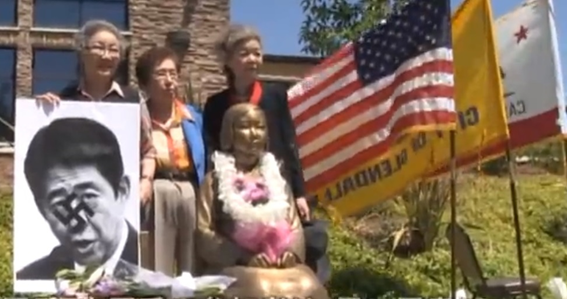
Radical Koreans' tenacious Anti-Japan campaigns have not slowed down but worsened in the last decades.   So much so, Koreans reached the point when they started criticizing the traditional Japanese flag, namely, the Rising Sun Flag, as the symbol of Japanese Imperial Militarism and equivalated it with the Nazi' Hakenkreuz, and Japanese Prime Minister Shinzo Abe (2006-2007 & 2012-2020), as Adolf Hitler. 

Korea’s bizarre behaviour is not entirely the successive Korean governments’ responsibility; the Japanese governments' weak-knee diplomatic attitude towards Korea is also accountable. The Japanese public's negligence in this matter also has to count.   Although Japanese academics have written significant volumes of Modern Japanese and Korean history, only a few have been translated into English or Korean, which has regrettably shaped the current situation.  We anticipate that publishing this e-book will be the first step in sending a message to the world that the Annexation of Japan-Korea was not by a military invasion.  It was the bilateral agreement of the Annexation Treaty between the Empires of Japan and Korea.   Through the Treaty, Japan helped the utterly regressed Empire of Korea to form a modern, democratic and industrial nation that claimed the achievement, “The Miracle of Han River (1961-1997).”

The prudent evidence that Japan treated Korean people compassionately is the upsurge of the average life expectancy and population growth during the Annexation time.  Life expectancy rose from 24 to 54 years, and population from 9,800,000 in 1906 to 21,120,000 in 1944.    


2.  Composition of the e-book (Part I, II and reference list)

Part I                                                                                                                                       
Introduction of the historical background of the Korean Peninsula in the turn of the 20th Century and dissent of Korea' claim of “Seven Deprivations.” 


Part II                                                                                                                                     
Presents photographs, newspaper articles and other documents concerning the Annexation period.  Photos with captions vividly depict the life of the Koreans, which would perplex Koreans and help others understand the authenticity of the relation between Japan and Korea during the Annexation period.  


3.  Accessing link to the e-book

https://drive.google.com/drive/folders/13GINjmcFIMCrFtxfGrYy8-1AYyFc_F2M?usp=sharing

Click the above to download. The file title is “The truth about Japan-Korea Annexation β version A-4 September 27, 2021, Final”. 

&

You can also find the article and access link on the Nadeshiko Japan home Page :

http://nadesiko-action.org/?p=16349 

http://nadesiko-action.org/wp-content/uploads/2021/10/The-truth-about-Japan-Korea-Annexation-β-version-A-4-27-Sept-2021-Final_compressed.pdf


4.  Plans for the future 

We aim to make this e-book into a paper book and publish and distribute it globally.  


Supporting Letter to Professor Ramseyer, Harvard University


On March 6, 2021, AJCN sent a cheering email to Professor John Mark Ramseyer, who published a treatise on the issue of Comfort Women and   has been personally attacked by anti-Japan Korean groups and American scholars. We have received a simple but polite reply from him.  AJCN supported the movement to get stop blaming Japan by distorting and forging the history of the Comfort Women issue, by revealing and disclosing the facts of history one by one, and partly we are in charge of these activities in Australia. 


Subject: Supporting Letter from AJCN


Dear Professor John Mark Ramseyer, Harvard Law School,

I am President of Australia-Japan Community Network (AJCN ) confronting Chinese and Korean anti-Japan organizations in Australia on the issue of Comfort Women since April 2014. You wrote the treatise about Comfort Women issue and many people supporting Korean baseless insistence on which Comfort Women were sex slaves abstract you personally not by logical counterargument.

We, AJCN want to support you in every aspect.

This is English version of our article in blog.

http://jcnsydney-en.blogspot.com/


I believe it contains contents that you can use as a reference when writing your counter-arguments.

I think  the articles below are the ones that are most strongly related to your opinion, so please read them.


A letter sent by AJCN to the Mayor of Mitte, Berlin

http://jcnsydney-en.blogspot.com/2020/10/a-letter-sent-by-ajcn-to-mayor-of-mitte.html


Letter to Melbourne Mayor

http://jcnsydney-en.blogspot.com/2020/01/letter-to-melbourne-mayor.html


Best Regards,


Sumiyo Egawa

President,

Australia-Japan Community Network


A letter sent by AJCN to the Mayor of Mitte, Berlin

On October 20, 2020, AJCN sent two letters to the Mayor of Mitte, requesting the removal of the statue of Comfort Women.

One is from a citizen's perspective and focuses on the issue of the statue of Comfort Women in Australia, and the other is an open letter format that focuses on Fact-based historical descriptions (with references). This blog publishes an open letter.


Open Letter


October 20, 2020
Mr. Stephan von Dassel
The Mayor of Mitte city 
Der Bezirlsbürgemeister,
Bezirksamt Mitte, Berlin Germany
bezirksbuergermeister@ba-mitte.berlin.de


Dear Mr Dassel,

Re: Comfort Woman Statue: A means for discounting, isolating and exploiting Japan

C:\Users\Owner\AppData\Local\Temp\enhtmlclip\Image(1).png
Figure 1. The opening ceremony of the Comfort woman Statue in front of the Glendale Central Library, Glendale California, the US; A woman holding a large portrait of the Japanese Prime Minister, Shinzou Abe with a Hakenkreuz (Swastika) on his face, propagating Prime Minster Abe as Adolf Hitler, July 31, 2013.


Introduction
My name is Sumiyo Egawa, a resident of Sydney Australia, and the President of Australia-Japan Communication Network (aka AJCN).  AJCN is a small volunteer group of Australian and Japanese parents, who are concerned about the safety and security of the minority ethnic groups’ children live in Australian.  The current activity of AJCN is mainly, protecting children of Japanese heritage from schoolyard bullying by other children who might be misinformed and misguided by Anti-Japan propagandists, in particular activists affiliated with Chinese and Koreans groups.
The purpose of writing this letter to you is to express my, the AJCN members, and many other Japanese (in and outside of Japan)’ disappointment and sorrow at the news that you have withdrawn the previous decision to remove Comfort Woman Statue from your city, the Mitte District of Berlin.   Your decision enables the Korean group to continue propagating their ambitious, corrupted and commercialized political Anti-Japan campaign until the Court's decision is delivered.  Through this letter, I am trying to explain the truth behind Comfort Woman Statue in order to avoid engulfing Mitte, an unrelated city, into an ugly dispute over Comfort Woman Statues, a matter of contention between Japan and Korea. 


Korean Comfort Women were Well paid prostitutes during WWII
Firstly, please consider the context that all “evidence” that Koreans claim support that the Imperial Japanese Military Force kidnapped 200,000 Korean girls and made them as sexual slaves (euphemized to Comfort Women during WWII) are based on malicious lies, designed to harm and discount Japan’ reputation.  
These Korean wartime prostitutes earned attractive amounts of incomes (equivalent or more than a Japanese Army Colonel’s income; for example, Ms Moon Okuju, one of the Ex-Comfort Woman’s bank account balance shows that she could buy three free-standing houses in Tokyo in the 1940s, attached Photo. 4) and worked at various brothels in Asian war zones*1.   The Imperial Japanese Military did assist and protect these prostitutes' movements from the Korean peninsula to various brothels and vice versa as there were no sufficient and safe means of transportation during the war.  The Japanese Army was also concerned for these prostitute’s welfare and health.  On the other hand, there were no major violent incident or mistreatment against prostitutes by the Japanese Military.  There was No major violent incident between prostitutes and Japanese soldiers reported in newspaper articles, official documents and primary sources available, except for one isolated case in Indonesia.  The Japanese Government has officially admitted the Semarang incidents in the Dutch East Indies, in where Ms Jane Ruff O’Herne and some other Dutch women were forced into prostitution by a few Japanese soldiers.  The Japanese Government has apologized and compensated those Dutch women, and the Japanese soldiers involved in this case were severely punished, and one of them was sentenced to death by hanging.  The late Ms Jane Ruff O’Herne was the only Ex-Dutch Comfort Woman, who campaigned against Japan with the Korean Anti-Japan propagandist group.  

A Deceitful Korean Citizens’ Group (NGO) and the Comfort Women Issue


I reprinted the article on the Nadeshiko Action website with the permission from Representative Ms.Yamamoto.
Japanese version is also posted on the Japanese AJCN blog.
                                     Secretary-General and President of AJCN 
                                                                   Sumiyo Egawa 


http://nadesiko-action.org/wp-content/uploads/2018/06/DSC02807-300x199.jpg

Human Rights Council 
Forty-fourth session
June–July 2020 (TBC)
Agenda item 4
Human rights situations that require the Council’s attention
Joint written statement* submitted by Japan Society for History Textbook, non-governmental organizations in special consultative status 

The Secretary-General has received the following written statement which is
circulated in accordance with Economic and Social Council resolution 1996/31.
[27 May 2020]
A Deceitful Korean Citizens’ Group (NGO) and the Comfort Women Issue

The Korean Council for the Women Drafted for Military Sexual Slavery by Japan (hereinafter KCWDMS), currently called The Korean Council for Justice and Remembrance for the Issues of Military Sexual Slavery by Japan (hereinafter KCJR), a Korean organization primarily centered on the comfort women issue and has criticized Japan in the United Nations Human Rights Council for “coercive recruitment into ‘sexual slavery’”, has allegedly defrauded its donors. The KCWDMS has had special consultative status with the United Nations Economic and Social Council (ECOSOC) since 2014.

Ms. LEE Yong-soo, a self-proclaimed comfort woman has long been active with the group. She is known around the world as the activist who screamed before the members of the US House of Representatives in 2007 during the deliberation on the resolution calling for an apology from the Japanese government over the comfort women issue. Recently, she asked President Donald Trump for a hug as an ex-comfort woman at the state dinner given during President’s visit to the Republic of Korea (ROK) in November 2017.

On May 7, 2020, Ms. LEE Yong-soo without hesitation stated the following at a press conference in Daegu, the ROK.

  1. The donations collected by the group were never used for former comfort women. The money was mostly used for private purposes and the responsibility lies with Ms. YOON Mi-hyang, who was the head of the group until this past March 2020.
  2. Ms. LEE’s testimonies about her days as a comfort woman were given as instructed by the group. 
  3. She was not a “sex slave.” She requested Ms. YOON Mi-hyang not to use the phrase because she did not understand why she was called one but Ms. YOON made it a point of using the phrase “sex slave” at the UN because “the expression was effective in scaring America.”


Based on these three points, it is clear that former president YOON
Mihyang allowed false testimonies to be made from those who call themselves "comfort women", including Ms. LEE, and misrepresented the comfort women as “sex slaves,” made use of the UN to spread the lie of the comfort women issue as a global women’s human rights issue and collected large amounts of donations from within and outside the ROK for her own personal use.

At present, former KCJR president YOON Mi-hyang has been denounced by several citizens’ groups, in addition to Ms. LEE Yong-soo, for suspected private use of donations and dubious accounting. The ROK’s prosecutors have started an investigation—prosecutors searched the KCJR premises on May 20 and 21, 2020.

UN Human Rights Council Fooled by Crooks

As has been repeatedly demonstrated in the past, Japanese "comfort women" were prostitutes who worked in warzones. This has been clearly stated by US Army Psychological Warfare Report No. 49 (official data of the US Army) dated October 1, 1944 made by the US Office of War Information (OWI), a report of captured Korean comfort women and their employers in Burma. The American interrogator stated that “a comfort girl is nothing more than a prostitute or professional camp follower” in conclusion.

The KCWDMS claimed that “Japanese administrative personnel coercively recruited 200,000 Korean women to make them comfort women and abused them as ‘sex slaves.’” However, on its face, this is clearly nonsense. In fact, many "comfort women" were obligated to engage in this line of work solely for the money. From 1930s to the middle of WWII, Korean criminal syndicates trafficked Korean women to Manchuria and China to become prostitutes. Really, most comfort women then who claim to have been "coerced" were victims of criminals. It should be noted that Japanese administrative personnel did what they could to enforce the law. Accounts of kidnappings and Japanese responses have been noted in the Dong-a Ilbo of the time.

Nonetheless, the KCWDMS outright lies to the UN, and denigrates the honor of Japan, striving to show its earnestness in combatting human trafficking.

Committee on Civil and Political Rights (CCPR), Committee on Economic, Social and Cultural Rights (CESCR), Committee on the Elimination of Racial Discrimination (CERD), Committee on the Elimination of Discrimination against Women (CEDAW), Committee against Torture (CAT) and Committee on Enforced Disappearances (CED) have recommended the Japanese government to “publicly acknowledge legal responsibility for the crimes of sexual slavery and prosecute and punish perpetrators with appropriate penalties” based on an opinion paper from the group.

In light of the circumstances, we request the following:


  • The matter of the KCJR (former KCWDMS), must be vigorously investigated and resolved by the Government of the ROK and the findings reported to the UN Human Rights Council. The UN Human Rights Council must immediately demand this action to the Government of the ROK.
  • The six human rights treaty-based bodies mentioned above made accusations against Japan based on KCWDMS’s falsehoods and deceit, and continuously issued misdirected recommendations to the Japanese government concerning the comfort women issue. We demand that the various human rights treaty-based bodies thoroughly investigate facts without swallowing the victims’ testimonies and produce a report. A scientific investigation based on facts is more important than anything.

International Research Institute of Controversial Histories (iRICH) NGO without consultative status, also share the views expressed in this statement.


Corruption of anti-Japan Korean organization


Sumiyo Egawa 
Secretariat-General and President of AJCN


May 7, Lee Yong-soo, one of former “Comfort Women” accused an influential activist group “the Korean Council for Justice and Remembrance for the Issues of Military Sexual Slavery by Japan” since this group is exploiting Women and exploiting money from Japan for Japan Bashing. She declared she would not attend Wednesday rally anymore,
When Mr. Michael Yon, my friend came to Sydney for supporting AJCN, he told me the “Comfort Women” are animals kept in a zoo called “The Korean Council for the Women Drafted for Military Sexual Slavery by Japan” and trained by it so that they have been main players at the anti-Japan campaign. The fraud and corruption of this group being revealed this time proves his words.

C:\Users\Owner\Documents\慰安婦像問題\2020慰安婦像問題\マイケル・ヨンとの写真.jpeg
Re: Michael Yon
■ Title
Photographer / journalist
■ Profile
Born in Florida, USA in 1964. He belonged to the US Army Special Forces (Green Berets) for 5 years in the 1980s. Since 2004, he has been a correspondent in the Iraq war and Afghan conflict. Report on 70 countries around the world is also receiving attention from major media in the world. He “re-discovered” the US government research report IWG report, which had been buried for nearly 10 years, and continues to research the truth of the “comfort women” issue. Recently He enthusiastically covered the Hong Kong issue and disseminated information about the Chinese Communist Party's oppression on Hong Kong citizens.

The following is an article of The Japan Times News published May 9, 2020 quoting the article of Kyodo published on May 8. The scandal is being pursued daily in South Korea, and a reassessment of the anti-Japanese activities affected by this group abroad will be also undertaken.

Ex-'comfort woman' in South Korea criticizes weekly protests at Japanese Embassy
The Japan Times News  May 9, 2020


Lee Yong Soo, a 91-year-old former South Korean "comfort woman," holds a news conference in the city of Daegu on Thursday. | YONHAP / VIA KYODO

KYODO
SEOUL – A 91-year-old former "comfort woman" in South Korea has criticized weekly protest rallies in front of the Japanese Embassy in Seoul, saying they preach hatred to young participants.
Lee Yong-soo's accusation, made at a news conference Thursday, marks a rare moment of dissent among veteran participants in the rallies that have been held 1,438 times every Wednesday since January 1992.
Together with a civic group that has organized the rallies and supported the comfort women who were forced or coerced into sexual servitude under various circumstances before and during the war, including abduction, deception and poverty, Lee has spent years demanding an apology and compensation from the Japanese government.
The wartime dispute has been one of the major issues straining ties between Japan and South Korea.
At Thursday's news conference in the southeastern city of Daegu, the nonagenarian accused the group, the Korean Council for Justice and Remembrance for the Issues of Military Sexual Slavery by Japan, of not using in a transparent manner donations collected from the public.

Lee also said she will no longer attend the weekly rallies, which draw many students from middle school through university, among other participants, and that the gatherings should end.
"The rallies only teach young students hatred," she said, adding that young generations of South Koreans and Japanese should interact more and become friendly to each other.
She also criticized Yoon Mi-hyang, former head of the group, for becoming a lawmaker after successfully running in the April 15 general election as a ruling party-affiliated candidate.
Her pointed criticism of Yoon may suggest some internal division within the group after the 55-year-old activist sought to enter politics.
On Friday, Yoon wrote on her social media account that all the donations collected by the group were subjected to thorough oversight and were used properly. She also emphasized the importance of the weekly rallies.
The civic group separately released a statement on Friday saying it was regrettable that there was some misunderstanding between the group and former comfort women.
"We will use this as a chance to look back on our movements during the past 30 years where we tried our best to be together with the victims as family and colleagues," the group said, pledging to work harder to help settle the comfort women issue with Japan and restore the women's rights and honor.


Letter to Melbourne Mayor


The unveiling ceremony for the Statue of the Comfort Women was held on November 14, last year in front of the Korean Society of Victoria in Oakley, Monash. Following the comfort women statue installed in the parking lot behind the Uniting Church Ashfield in Sydney, it is the second in Australia and since the one overseas was established in Glendale, California, USA (July 2013), the 10th body this time. Mayor of Hwaseong, who is visiting Australia also attended the unveiling ceremony. Hwaseong-City, Gyeonggi-do, Korea, actively supported the installation of statues overseas, and the city has supported and installed statues in Toronto, Canada (November 2015) and Shanghai, China (October 2016). It is the third body. The statue installed this time is the same as the one that Hwaseong City installed in Dongtan central park in August 2014, and was temporarily suspended at the Aichi Triennale 2019, an international art festival held in Aichi Prefecture. It is the work of Kim Eun-sung / Kim Seo-gyeong who produced the statue of the girl who was exhibited at the exhibition " Inconvenience of Expression and afterwards". “ The construction of the statue of the girl began with the intent to heal the wounds of the victims of comfort women and to inform the world of the sexual abuse of the Japanese army, '' said Hwaseong Mayor, saying Hwaseong citizens and Melbourne Koreans aiming for peace and I hope that my brothers' compelling wishes will be transmitted to the world.

The comfort women in Sydney and Melbourne have the same body design, but the groups that promoted the installation are different. In early November, AJCN sent a letter to the mayor of the city of Monash, administrative district where the statue exists, concerned about the unveiling of the comfort women statue in Melbourne. It is an eight-page long sentence, described the essence of the comfort women statue issue in Australia, beginning with the promotion of the first comfort women statue by the Chinese and Korean anti-Japanese organization and the other group pushing the opposition around in the second installation promotion campaign.

AJCN explained in detail the background and the foreign forces behind the promoters, which were set up behind the church building and are now being set up in Melbourne, with photographs and supporting materials.

The full text of this letter is published here. I think that you can understand the whole picture of the comfort women statue issue in Australia if you read this. AJCN has received a reply from the mayor stating that the city recognized this issue and that no application has been made in public places.


E:\WORK\logo\For web\AJCN_letterhead_vic.png
Mr. Shane McCluskey
Mayor, City of Monash


3 November 2019

Re: Comfort Woman statue which Korean anti-Japan group plans to unveil 
at Korean Society of Victoria in Oakleigh on 14 November, 2019

Dear Mayor McCluskey,

My name is Sumiyo Egawa, Secretary-General of Australia-Japan Community Network. We are a group of Japanese and Australian parents who gathered to protect our children from bullying and harassment caused by activities conducted by politically motivated people and organisations. We have been opposing the erection of so-called comfort woman statues in any public or private places visible from roads and streets because such statues have always been politically utilized and causing unnecessary disharmony in local communities that often leads to hostile acts against children of Japanese heritage.
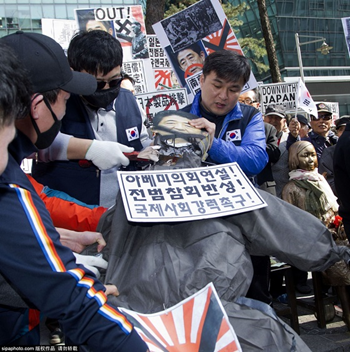
Completely apart from interpretation of historical facts we have a numerous number of reasons to believe this statue has been promoted as a political tool causing unnecessary animosity and division to local communities.  For this reason, Strathfield Council unanimously declined the Korean and Chinese proposal in 2015 as more than 70% of residents voted No to the statue. This kind of statues have been erected all over the world, and demonstrations taking place beside the statues are clearly political, racial and often violent.  We consider this is a huge intimidation to the Japanese nationals.  Please see the photos below for your references.  What further concerns us is the fact that those specific Korean people promoting the statue are trying to break the governmental mutual agreement proposed by both Japanese and the South Korean governments. This agreement is implemented with the aim to provide assistance to the families of deceased comfort women and surviving comfort women, and Australian government officially announced that they also support this agreement as well. We hardly understand why we can not let the two governments settle and build a better relationship for the future.  This statue is a clear symbol with the intention of disregarding the governmental agreement.

C:\Users\Owner\AppData\Local\Temp\enhtmlclip\Image.png
Mr. Abe beheaded beside the statue. Photography taken in South Korea

C:\Users\Owner\AppData\Local\Temp\enhtmlclip\Image(1).png
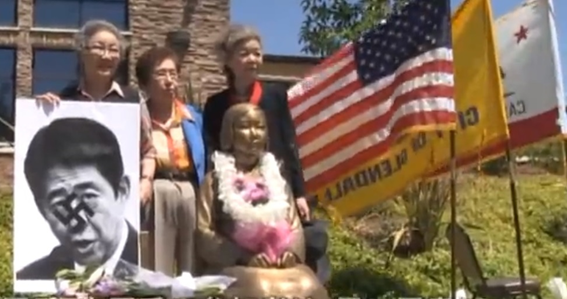
One of the ceremonies held in the U.S. to promote the “comfort women” statue.

Australia is a multicultural country believing that all people should be able to live in harmony and enjoy freedom from discrimination. To erect a statue that demonizes one nation in the name of Women’s Human Rights is in direct conflict with the nature of said multiculturalism. The statue erected in Glendale, California is proof that these statues generate hate rather than love. I attached our presentation material, "Harmony must come first" and Letter from Mother in LA for understanding what happened surrounding the statues. No matter who claims that this statue represents the human rights and dignity of women, you can understand how this statue is political and symbolizes hatred. To erect the statue potentially creates a hostile environment for local Japanese residents and their children. It also assists these politically motivated anti- Japan forces to drive a wedge between Japan and Australia which is their major operational intention outlined in the book “Silent invasion” written by an Australian academic, Dr.Clive Hamilton and plotted by the authoritarian, communist regimes who are supporting and financing this agenda. 

The "Comfort Women Statue" issue began in Sydney in February 2014 when the Chinese and Korean alliance called "The United Austral Korean-Chinese Alliance against Japanese War Crimes" (KACA) held a meeting to announce the ten goals of their anti-Japan lobbying which included their political activities such as "to lobby the Australian Prime Minister to put less importance on foreign diplomatic relationships with Japan" and "to erect the Comfort Women statues in all regions of Australia". Since that time, we have observed various figures of the anti-Japan alliance (and of the associated individuals/ organisations) that took part in endorsing the statue to be erected in Sydney. 

1. The first movement for erecting the Comfort Women statue
(The proposal for the erection was rejected by Strathfield City Council on August 11, 2015)
The organisation that submitted a proposal to erect a Comfort Women statue in the square in front of Strathfield Station is an anti-Japanese organization called KACA.
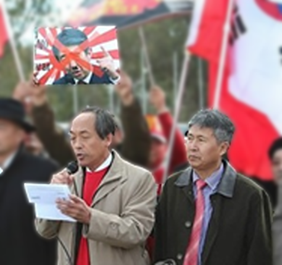
In September 2014 issue of the "Journal of the Korean Society of Sydney", KACA posted a totally political declaration called “The Eight Objectives”.  In it KACA stated that it would work for the interest of Korea and China. (Please refer attached “The Eight Objectives/Points”) When Japanese Prime Minister Abe visited Australia in July 2014, KACA disseminated an open letter to parliamentarians, state councils and the media, criticizing the Japanese government and demonstrated in front of the National Assembly in Canberra.
C:\Users\Owner\AppData\Local\Temp\enhtmlclip\Image(2).png
(Mr.Ok speaking at that time with Mr. Song, leader of KACA standing by his side, taking part in an anti-Japan demonstration in Canberra, July 2014)

Mr. Sang Ok, the Deputy Mayor of Strathfield at the time, was the chairman of KACA. In 2015 he was replaced by Mr. Luke Song, the former chairman of KSSA (Korean Society of Sydney, Australia). Mr. Luke Song wrote several extreme hate comments on KSSA’s website regarding the Abe cabinet and the Japanese Australian residents while he was the chairman of KSSA. Mr. Song insists that the proposed statue was only to enhance woman’s human rights.  Nonetheless, he used language such as “destroy Shinzo Abe and the Japanese who are dreaming of reviving militarism” and “we are fighting against our enemy to end our sad history”. These strong aggressive words and statements are very common from all the anti-Japan Chinese Korean alliance groups around the world . In September 2014 they released their mission statement in a Korean newspaper in Sydney in which they stated the following: 
"We will urge the US government not to be deceived by Japan, acknowledge the dark evil intention of Prime Minister Abe, stop remilitarization of Japan and change their foreign policies that put Japan first before Korea and China."
"Three Sisters", the Comfort Woman statue, which was proposed to be erected in Strathfield was designed by a Chinese artist and allegedly the cost of the production was to be born by the CCP, the Chinese Communist Party.

2. The second movement for erecting Comfort Women statues
The trigger for beginning stage two of this campaign of erecting comfort women statues was the agreement made between the Japanese and Korean governments to finally settle the Comfort Women issue on December 28, 2015. “Chong Dae Hyup”, an anti-Japan political group which is closely related to North Korea, opposed this governmental agreement and began their monthly Wednesday demonstrations all over the world. In response to this, FCWS (Friends of Comfort Women in Sydney) and Project Group Sysochu (Peace Statue Establishing Committee in Sydney), were formed in Sydney and they started monthly Wednesday demonstrations in Sydney and Brisbane. Many of the members of the two groups, however, are the same people and they really are just one organization. This includes members belonging to existing organizations such as KACA, The Korean Cultural Center Inc. and KSSA.  Although Mr. Luke Song, Chairperson of KACA appeared to disappear from the scene following his failure to erect the statue in Strathfield, he consequently visited the Uniting Church in Ashfield on 22 February 2016 with FCWS members to discuss with Rev. Crews about relocating the statue to the Uniting Church ground.
C:\Users\Owner\AppData\Local\Temp\enhtmlclip\1.png
Centre: Rev.Bill Crews, Left: Ms.Vivian Pak ,Current leader of FCWS, Right: Mr.Luke Song,Chairperson of KACA

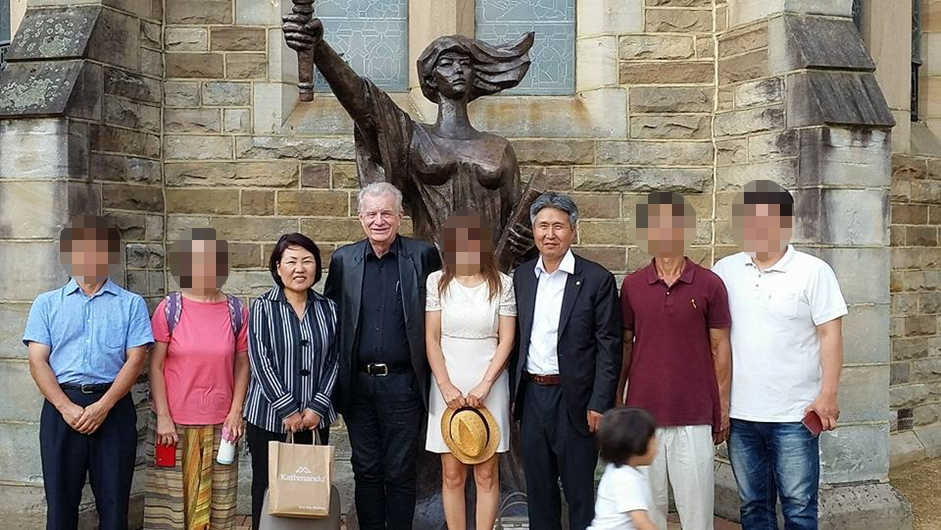
The purpose of this anti-Japan activist group is to tear down the Japan-ROK agreement, and demand the Japanese government pay even greater reparations to ex-Comfort Women. The preparatory work to erect the statue was sponsored and carried out under the direction of Chong Dae Hyup. Please see below further information regarding the people involved, who attended the unveiling ceremony on 6 August, 2016 .

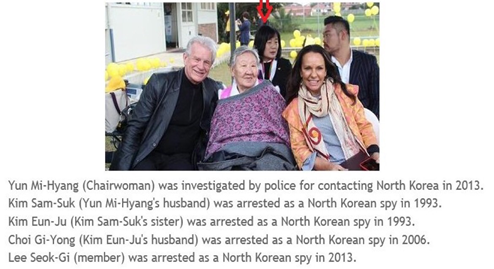
About Chong Dae Hyup and its leader, Ms. Yun Mi-Hyang
The main player who brought the statue to the Uniting Church in Ashfield was Chong Dae Hyup in 2016.  At the initiative of Chong Dae Hyup, the campaign activities were carried out by young Koreans holding working holiday visas and student visas. The below photo is taken in unveiling ceremony held in 2016. Front left is Rev.Crews and back left is Ms.Yun Mi-Hyang.   Former Chong Dae Hyup changed to the Name of the group to "The Korean Council for the Women Drafted for Military Sexual Slavery by Japan War."

C:\Users\Owner\AppData\Local\Temp\enhtmlclip\Image(3).png

About Friends of Comfort Women in Sydney (FCWS)
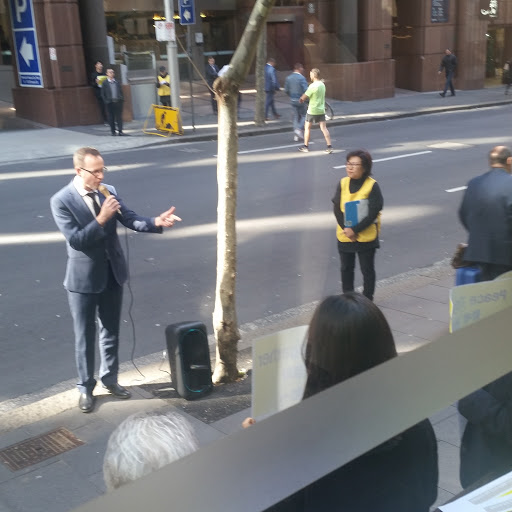
The anti-Japan demonstration held on 14 August 2019 in front of the Consulate General of Japan Sydney organised by the Korean anti-Japan activists by the name of “Friends of Comfort Women in Sydney” (FCWS)  The leader is Ms.Vivian Pak who acted as MC in this demonstration.
C:\Users\Owner\AppData\Local\Temp\enhtmlclip\Image(4).png
Mr. David Shoebridge MLC,Parliament House made a speech allegedly what he said was factually untrue and no more than politically motivated anti-Japan propaganda which is highly insulting.
Left: Mr. David Shoebridge  Right: Ms.Vivian Pak

Although we sent a letter of protest to Mr.David Shoebridge and the Headquarters of the Greens, they replied nothing to us. As FCWS and its main members may be regarded as the agents of North Korea or Chinese Communist Party, they are subject to surveillance of Australian security agencies. Australian government and ASIO realise that the erections of the Comfort Women statues are a part of activities of the anti-Japanese Korean group is said to be just a glove and the hand inside that moves this glove is the CCP, in this worldwide anti-Japan lobbying. Since these Korean anti-Japan activities are being utilised as a part of the Chinese Communist Party’s information operation attempting to cut the ties of the alliance between Japan, The U.S. and Australia.

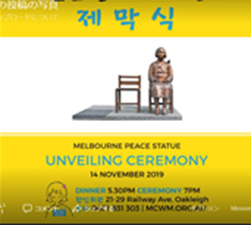
About who intends to erect the Comfort Women statue in Melbourne
I found the invitation notice of the unveiling ceremony in Melbourne in the Facebook site of FCWS. This time the promoter is  "Melbourne Comfort Women Memorial Task Force" led by Chunje Cho, President MCWM Task Force. I believe this group works with FCWS.
The ceremony will be held at Korean Society of Victoria, 21-29 Railway Ave, Oakleigh VIC 3166.

C:\Users\Owner\AppData\Local\Temp\enhtmlclip\Image(5).png
The issue for us is where they will bring the statue after the unveiling ceremony.
We would like you not to permit this statue will be put on the ground of public place or private place visible from roads and streets.

In conclusion, we can only see one reason for this statue and that is to create ill feeling at the least, and hatred, at the worst, towards Japan and its people and the people of Japanese heritage residing in Australia. This goes against all that being a multicultural country stands for.
If this statue is built in a publicly visible place, as exemplary citizen of the world for more than 70 years since the end of war, we will strongly challenge against the erection of the statue to protect  peaceful Melbourne.

Sumiyo Egawa

Scretary-General and spokesman
Australia-Japan Community Network Inc.


Comfort Women Statues Shame, Not Help, Koreans

Mr.Archie Miyamoto served on active duty in the US Army for 29 years. He served two tours in the Korean War and two tours in the Vietnam War. He served two tours as a military advisor in Taiwan and also two tours in Japan, the first as a platoon leader in the 187th Airborne Regiment and once as the joint defense planning coordinator between US Forces Japan and the Japanese Self Defense Force. His military decorations include three Legion of Merit, the Distinguished Flying Cross, two Purple Hearts and the Bronze Star. He has already retired. Since he is indignant at "Comfort Women" propaganda of  Chinese Communist Party and South Korean activists, he has written the letters to the mayors and city councils of relating cities to prevent the erection of  Comfort Women statues as a former Japanese American veteran. His efforts contributed greatly to success in preventing the installation of some statues. His "Wartime Military Records on Comfort Women" is the Fact-based work that Journalist Mr. Michael Yon  praised a lot. This article is Mr.Miyamoto's latest article.

Comfort Women Statues Shame, Not Help, Koreans


By Archie Miyamoto, Lt. Colonel, U.S Army, Retired


 The comfort women statues that continue to proliferate in the United States, Europe, Asia, and elsewhere have an unseen consequence. Their tacit indictment of wartime populations is seen as cowardly and indicates the lack of concern with protecting vulnerable women.

As the world still waits for proof of activists’ claims that 200,000 women — many, if not most, of them Koreans — were forcibly abducted by the Japanese military and made to work as comfort women, we should remember that there is another gaping evidentiary hole.

If hundreds of thousands of Korean women — and hundreds of thousands of women from other countries, as some activists like to contend — were systematically kidnapped from their homes, shouldn’t there be evidence of massive resistance on the part of their fathers, grandfathers, brothers, and uncles?

While the silence of a population in the face of such alleged horrors may be understandable in a country under military occupation, Korea was not occupied. It was part of Japan during the annexation period.


Not Under Military Occupation 

Koreans were well-integrated into Japanese society and work force during the annexation period. In addition to holding public offices and serving in the police force, hundreds of thousands of Korean men served in the Japanese military.

Many served as officers and a few as generals. Lt. Gen. Hong Sa Ik, head of PW Command of Japan’s Southern Army, is an example of a Korean in command of Japanese troops.

Prince Yi Wu, grandson of the Korean Emperor Gojong, served as a colonel in the Japanese Army. When he was killed by the atomic bombing of Hiroshima, his aide — a Japanese officer — felt he had failed to properly protect Prince Yi and committed suicide. Is this the action of a man who saw Korea as a “brutalized slave colony”?


Passive Cowards, Opportunists? 

Charges that earlier generations did nothing as hundreds of thousands of women were abducted are an indictment of the entire wartime generation of Koreans. A whole generation must have been exceptionally — and uncharacteristically — passive to allow such an injury to their wives, daughters, and granddaughters. (RELATED ARTICLE: Korea: Daddy Don’t Leave Me!)

The allegations also fly in the face of the deep respect Koreans are known to have for their elders. Even former comfort women attesting to abductions make no mention of their parents (or anyone else) resisting or trying to prevent their alleged kidnappings.

One former comfort woman said she was reported as simply missing.

It is plausible to argue that one person simply vanished, but simply incredible to argue that 200,000 young women just disappeared. 

The accusations of mass abductions in effect portray one’s grandparents’ generation as cowards and opportunists who sold out their daughters and granddaughters to the Japanese.

This is shameful, and it is a gut-wrenching insult to elderly Koreans.


Documents Tell A Different Story

Allegations are one thing, but facts are another.

World War II military documents provide overwhelming evidence on the true nature of the comfort women system. (See Wartime Military Records on Comfort Women by this author.). In addition to the oft-quoted “Japanese Prisoner of War Interrogation Report No. 49,” there are additional documents, including the following:


There are additional documents from Dutch, Australian, and Japanese sources, and even the diary of a Korean operator of a comfort station.


What Contemporaneous Reports Say

The many contemporaneous records of the allied forces at the end of the war clearly identify comfort women as contract prostitutes, not dragooned sex slaves.

Wartime reports of Japan’s Ministry of Foreign Affairs on Japanese and Korean businesses in Chinese cities list comfort stations not as something special but as just another business. Comfort stations with Korean women were operated by Koreans and those operated by Japanese operators had only Japanese women. None were operated by the military.

Following the same pattern, in the Philippines, Japanese military records clearly stipulated that local brothels for use by Japanese soldiers would employ only licensed prostitutes.


War crimes involving the recruitment of prostitutes 

While prostitution was legal at the time, recruiting involuntary women as prostitutes was a war crime – including under Japanese law.

There is only one case of involuntary recruitment found in the U.S. war crime records [HQ, Island Command, Guam, Serial No. 846, May 12, 1945]. It involved a Japanese civilian on Guam pressuring two women into prostitution.

The U.S. war crime records are consistent with the finding of authorities in other locales as well. In Indonesia, fewer than half a dozen cases were tried by Dutch authorities. The Bart von Poelgeest Report issued by the Dutch authorities clearly points out that forced prostitution was prohibited by Japanese military regulations.

Other than the incidents mentioned, there are no records of forced prostitution.


What Really Happened 

The interrogation of three Korean civilians employed by the Japanese Navy describes what would have happened if the Japanese had abducted or conscripted Korean women as sex slaves. “MIS, Composite Report, List 78, 28 Mar 45” (page 3, item 18) states:
All Korean prostitutes that PoW have seen in the Pacific were volunteers or had been sold by their parents into prostitution. This is proper in the way of Korean thinking but direct conscription by the Japanese would be an outrage that old and young would not tolerate. They would rise up in anger killing Japanese no matter what consequences they might suffer. 
This more accurately describes how Koreans would react, especially the family members of the women being abducted.

Even involuntary conscription by means other than direct abduction would have resulted in riots.


Question of Practicality

The Japanese military was deployed on many different fronts and in many different campaigns. It had neither the leisure nor the capacity to round up and guard 200,000 women who were allegedly sex slaves from among hostile populations speaking foreign languages.

In some cases, critics have carelessly lumped the official recruitment of women for the factory labor force together with the private comfort women industry.

The Women’s Volunteer Labor Force, known as the Teishintai or Chongsindae in Korean, was used to mobilize unmarried young women for factory work in late 1944. It had nothing to do with the comfort women system.

By this stage of WWII, Japan was undergoing aerial bombardment and fighting for survival. To be blunt, sex was the last thing on anyone’s mind as cities burned and millions of people began to go hungry.

Over the course of more than seven decades of postwar history, many have lost sight of these wartime realities and complexities.

Humans in general tend to side with victims of injustice, and today World War II in the Pacific is often presented as a one-sided conflict in which everything that Japan did, from the battlefield to the bureaucracy, is somehow fraught with evil intentions.

But as is evident from the many original military documents, the sex slave narrative can be seen for what it is — a hate campaign to demonize Japan today, which has nothing to do with Japan’s WWII past.

Comfort women statues are part of that strategy to demonize and delegitimize Japan in the eyes of the international community.

But, let us remember that these statues also tacitly indict Koreans as cowards who did nothing as a generation of young women was stolen from their midst.

Today’s anti-Japan monument is also tomorrow’s insult to those populations under Japan’s wartime administration.


Author:
Archie Miyamoto served on active duty in the US Army for 29 years. He served two tours in the Korean War and two tours in the Vietnam War. He served two tours as a military advisor in Taiwan and also two tours in Japan, the first as a platoon leader in the 187th Airborne Regiment and once as the joint defense planning coordinator between US Forces Japan and the Japanese Self Defense Force. His military decorations include three Legion of Merit, the Distinguished Flying Cross, two Purple Hearts and the Bronze Star. After retirement from the military, he served as project manager of a subcontract on an Israeli military airfield construction project to the Negev Desert. After that he joined a Japanese corporation (Maruzen of America) in Los Angeles and became its President/Chairman. He is currently retired.


Original article : JAPAN Forward "Comfort Women Statues Shame, Not Help, Koreans"


Comfort Women Propagandists Getting Increasingly Desperate:

Even Youtubers Easily Disprove Latest South Korean Lies

Tetsuhide Yamaoka, President, AJCN Inc.

Shocking video footage was released by personnel of the Seoul city government and Seoul University at an international conference held in Seoul on February 27 of this year. According to the releasers, the brief film clip shows the corpses of dozens of WWII Korean sex slaves dumped after having been raped and killed by Japanese soldiers. The Seoul University and city government personnel contend that the never-before-seen footage was taken on September 15, 1944, in Tengchong, in China's Yunnan Province, and was discovered at the American National Archives and Records Administration in Washington, D.C.


However, this disturbing announcement was flatly ignored by major Japanese media outlets—including even the Asahi Shimbun newspaper, which once ran a lengthy campaign of comfort women articles based on Seiji Yoshida’s lies about having abducted Korean women on Jeju Island under government orders. While a number of Korean newspapers touted the footage as new evidence of a “comfort women massacre,” even left-wing Japanese scholars declined to comment on the video.
Why? The reason for the Japanese media’s and scholars’ reticence is obvious: the film footage is nothing new, and the Seoul University and Seoul city government personnel’s description of what is shown in the footage is blatantly false.

One of the first to counter the fake Seoul narrative with hard evidence was Tony Marano, the popular Youtuber known to many as “Texas Daddy”. On his YouTube channel, Marano released an official document prepared by the US military in 1944 which gives a precise description of what is taking place in the film clip.

https://youtu.be/zbvwHivABzM

Marano was able to retrieve this film contents description card from the American National Archives and Records Administration. In fact, the card is stored in exactly the same place as the video footage itself.

 
The card attached to the film footage reveals that the dead bodies in the film are actually Japanese soldiers and civilians (women and children), and that the Japanese corpses are being looted and desecrated by a Chinese soldier. The video footage clearly shows a Chinese soldier stripping socks off dead bodies—just as is listed in the descriptive card.

While the video footage may have been newly discovered, the photographic still images taken from the film were known and analyzed by Waseda University professor Toyomi Asano some 20 years ago. In his report, compiled in 1999, Prof. Asano concluded that the victims shown in the images were killed while attempting to escape from a nearby stronghold during a battle, and that their corpses were left unattended for a long time. Prof. Asano recently added a further comment, in response to the Korean release of the video footage, that it would have been both impossible and irrational to take all of those women and other civilians from inside the stronghold and execute them under enemy fire outside the stronghold during the battle.

In fact, the existence of comfort women was common knowledge at that time, so there would have been no reason for the Japanese military to conceal what was already known publicly. And at any rate, even if the Japanese military had tried to execute the comfort women as part of a cover-up operation, would they then have left the corpses piled up like that, exposed in an open pit?

So much for the details, but a much larger question looms. Why do Koreans keep releasing historical “evidence” that is so easily disproven and dismissed? Tony Marano is not a professional researcher, but he was able to retrieve the descriptive card online with minimal effort from the same American National Archives and Records Administration where the Korean group claimed to have discovered the video footage. The Korean group must also have found the same card themselves, and thus known that the video footage clearly did not show a comfort women massacre.

Perhaps Koreans consider their purpose met as long as the general public in South Korea believes the ginned-up comfort women narrative and gets infuriated towards Japan? It has been well recognized in Japan for quite some time that anti-Japan Korean activists have little interest in the truth. Yet aren’t the Seoul municipal government and Seoul University supposed to be slightly more professional than run-of-the-mill anti-Japan demagogues? Or have we reached a point where prejudice runs so deep that it blinds even those at the highest levels of South Korean society to obvious historical fact?


Sympathy for Korean Comfort Women Now & Then


Tetsuhide Yamaoka
President of Australia-Japan Community Network Inc.


“You are denying comfort women!”
An Australian journalist well known for his hatred of the Japanese Imperial Family yelled at me over the phone.
“No,” I replied. “Of course the comfort women existed. Nobody is denying it as far as I know.”
“Then why don’t you honor them?”
“We do honor women’s human rights. Yet we do not agree with what the Korean activists claim.”
He then grew even more irritated and aggressive. When I asked him to calm down, he lost his temper and hung up on me.

The reporter’s tantrum notwithstanding, I strongly believe that we should be deeply sympathetic towards Korean women. Their plight has been hard. Before Japan’s annexation and modernization, Korean women born in the lower social classes were literally enslaved and traded against their will. There were Korean officials who forcibly took women away from their homes in order to send them to the rulers of China as tribute payments. Desperate parents sometimes hid their daughters or even scarred their faces to spare the young girls such a fate. Because of this lingering historical trauma, an elderly Korean gentleman once explained to me, Koreans were well primed to believe the “comfort women abduction narrative” fabricated by a con man called Seiji Yoshida and spread by the Asahi Shimbun newspaper.

These practices were banned under Japanese rule, but the underlying feudalistic attitude of male dominance remained into the modern era. Before the arrival of the Japanese, Koreans had seen little use in educating females, who overall suffered much worse oppression than their counterparts in Japan. Young girls fleeing home were easy prey for human traffickers, and many ended up in prostitution.

During the annexation era, the Japanese introduced into Korea the licensed prostitution system already widespread in Japan. While the complete eradication of prostitution proved impossible, the licensing system strictly controlled pre-existing prostitution engendered by human trafficking. It was still not uncommon in Japan at that time for poor parents to sell their daughters to brothels under contract, especially in the poverty-stricken north. The government established strict rules for this baneful custom in the hopes of eventually eradicating it.

The Korean peninsula was much poorer than Japan, so when the Japanese system was introduced there it ended up allowing Korean parents to legally sell their daughters to brothels. Kim Hak Sung, the first former comfort woman to come forward during the 1990s, once testified that she was sold to a kisaeng (female entertainer) house by her mother. The law stipulated that such transactions were illegal without the consent of the daughter, who had to be released once she had paid off the advance payment provided to her parents. However, Professor Lee Yong-hoon of Seoul University contends that Korean pimps forcibly took away daughters even when they refused to consent to it. But even without the intervention of these pimps, daughters in Confucian Korea had little power to refuse their parents’ commands.

Japan’s military comfort woman system was an extension of the prevailing licensed prostitution system, which was in turn grounded in the ancient Korean practice of human trafficking in women. The Japanese government should reiterate that, by today’s standards, such a practice would be—indeed is—unthinkable. However, by the same token, countless records show that Japanese police arrested Korean brokers who were deceiving and kidnapping local women. While laboring under the strictures of vicious local customs, the Japanese during the colonial period still strove to ameliorate the positions of vulnerable females.

Activists portray the comfort women issue as black and white, and Japan as uniquely evil. But the system was clearly not a simplistic perpetrator-victim relationship. Korean parents and Korean vendors played a significant role. Furthermore, Korean men who joined the Japanese Imperial Army used the comfort women just like all the other troops. Conscription did not take place on the Korean peninsula until September 1944, less than a year before the end of the war. Yet by that time, hundreds and thousands of Korean men (who were Japanese at the time) had already volunteered and were serving in the Japanese Imperial Army. In their private meetings at the comfort stations with Korean comfort women, those Korean troops would have been able to communicate with the women in their own language. If even one woman had mentioned having been forcibly abducted, the Korean troops would have rioted against their commanding officers. This is not speculation—Korean POWs told their Allied captors as much. Korean men knew that the comfort women servicing them had either signed up voluntarily or else had been sold by their parents. The latter practice was so common that even heavily armed Korean soldiers showed no reaction when meeting Korean women who had been trafficked in this way.

The fact is, though, that there was technically no nationality at the time of “Korean”. Koreans were Japanese then. They fought and lost as Japanese citizens. They collaborated in the comfort woman system, as did their fellow Japanese. If the comfort woman system is considered criminal, then Koreans are accomplices. They switched sides when Japan lost and quickly took the position of victim, hiding their own participation and responsibility.

But the time for falsehood and victim politics is over. If Koreans are genuinely concerned with women’s human rights, they should be scrambling to rescue the tens of thousands of Korean women trapped in prostitution all over the world right now. These modern-day victims of human trafficking are at this very moment suffering at the hands of the same vicious brokers whom the Japanese authorities cracked down on in Korea nearly one hundred years ago.


Setting the Record Straight: Comfort Women and Compensation


The comfort woman system did exist during the World War II. It was built by the Imperial Japanese Army to prevent sexual crimes, STDs, and spying. The similar system was adopted and operated by the South Korean Military Force during the Korea War and the Vietnam War for own soldiers as well as soldiers of allied nations.

But the comfort woman system was not the invention of the Japanese military. As Professor Park Yu-ha of Sejong University points out, the comfort women system was a systematization of the commercial prostitution system which already existed at the time. Prof. Park stresses that comfort stations took various forms depending on location and time built.

By the same token, there were a variety of women working to serve soldiers. Prof. Park contends that only Japanese women, along with Korean and Taiwanese women who were Japanese at that time and served with a sense of patriotism, should be referred to as “comfort women.” Apart from these women, there were women at ordinary prostitution facilities also engaged in sex work, but not exclusively for the “comfort” of the Japanese military.

Women in prostitution were socially weak and vulnerable in general. Some were sold by their parents or deceived by vicious brokers and susceptible to exploitations even if they earned some money under their contracts. Prof. Park argues that Japan’s responsibility for Korean comfort women should be accounted for in its annexation of the Korean Peninsula, which became a source for comfort women. This accounting should be undertaken from a moral standpoint. Conversely, the forcible abduction of women off the streets and from normal households by military forces was hardly plausible, and so there is no need for the Japanese government to apologize for something that did not happen. In other words, the moral reckoning must be grounded in remorse for real actions, and not subsumed to political calculations.

Probably the most famous figure brought up as a symbolic victim of the comfort women system is Ms. Jan Ruff-O’Herne who was subjected to a gruesome war crime in Indonesia during World War II. Where do women like Ms. Ruff-O’Herne fit into the whole picture of the comfort women argument?

Prof. Park says that the Dutch women such as Ruff-O’Herne, who were forced to provide sex to soldiers, were not comfort women but clearly victims of crimes. The criminal perpetrators were punished as individuals. It is important to clarify this, because it shows, among other things, that the Japanese military, contrary to much of what is now said about the imperial forces, was the first advocate for the safety of the comfort women.

Ms Ruff-O’Herne was a victim of a dreadful crime known as the “Semarang Incident” (February 1944), which took place in Indonesia, a colony ruled by the Dutch for 300 years. The Semarang Incident saw the rape and forcible detention of 35 Dutch women by a small group of Japanese Army soldiers and prostitute-brokers.

These soldiers and prostitute-brokers violated the strict moral guidelines issued by the administrative office of the 16th regiment of the Japanese Army in Djakarta, Indonesia. They forcibly removed the 35 women, aged 17 to 28, from three Dutch internment camps, confining them in four brothels in Semarang. The soldiers and brokers then raped the women repeatedly, holding them at length against their will.

During Colonel Kaoru Odajima’s inspection of the Dutch internment camps, a leader of the Dutch detainees (whose own daughter had been among the abductees) reported coerced human mobilization of Dutch women from camps by some Japanese Army officers and prostitute-brokers. Upon receiving the Dutch leader’s information, Col. Odajima ordered the 16th Army regiment headquarters to immediately release all the abducted Dutch women. Col. Odajima also ordered the closure of the four brothels in Semarang.

The eleven perpetrators (soldiers, prostitute-brokers, and brothel-operators) were court-martialed. After the war, the offenders were classified as B and C war criminals during the Batavia War Crimes Temporary Tribunal in 1948. They were found guilty and sentenced. Major Keiji Okada, believed to be responsible for the entire incident, was executed, and the others were imprisoned.

Furthermore, Army Colonel Asao Ōkubo, who was believed to be the ringleader of the group, was returned to Japan at the end of WWII. He committed suicide, fearing he would be summoned by the Batavia War Crimes Temporary Tribunal before it was dissolved. Eventually, 25 out of the 35 abducted Dutch women were officially recognized as victims of coercive human mobilization and rape by the Japanese Army soldiers and prostitute-brokers.

According to the 1994 report by the Dutch government, there were about 200-300 Dutch women working in brothels in Indonesia during WWII, of which at least 65 were said to be victims of forced prostitution. The others were sex workers.

This issue has been resolved between the Netherlands and Japan. The Dutch government officially acknowledged its absolute closure. The Japanese government established the Asian Women’s Fund in 1995 with about $ 4.5 million in order to compensate the victims of these crimes. By 2001, reparations to the Dutch victims had been paid in full, and the cases were closed.

Many people criticized the fund due to its being private, and not official. In fact, the fund was supported by the Japanese government with a fiscal injection, but it remained de jure private for the simple fact that all war-related compensation was completed upon the execution of the Peace Treaty in 1952. Many Japanese individuals donated to the fund in order to express their sympathy for what the women suffered in the war. The record of the Asian Women Fund shows that 79 Dutch women received goods and services valued at an average of approximately 50,000 guilders (3 million yen) per person, along with an apology letter from then Japanese Prime Minister Ryutaro Hashimoto.  Ms Ruff-O’Herne refused to receive them at her own will.

Unfortunately, the comfort women issue—which should be about rendering justice to those who suffered—is no longer about the women themselves. Anti-Japan political activists in East Asia and elsewhere with connections to North Korea and the Chinese Communist Party are now exploiting the comfort women issue for their own ends.

As Prof. Park Yu-ha recommends, Japan must make amends for things that actually happened in the past. The record shows that Japan has done this, time and time again. While communist forces attempt to turn the comfort women history into the comfort women political issue, we must refuse to be embroiled in political sidetracking. Justice demands no less.


Tetsuhide Yamaoka
Researcher
The Institute of Moralogy


Korean Comfort Women arrested and interviewed by US soldiers in Burma,1944
Source: The National Archives of the United States

Professor Park Yu-ha
Source: The Asahi Shimbun

Ms.Jan O’Herne
Source:ABC News


Stop "Comfort Women Statues" and Protect Japanese children and youth in Australia from Racial Discrimination, Bullying and Harassment!


AJCN started the following fundraising activities. Please cooperate to protect Japanese children living in Australia.

Donation site: https://www.gofundme.com/t2nvb
Payment with credit card is accepted on this site. If you would like to transfer directly to an account please transfer to the account below.

Japan: ゆうちょ銀行(Japan Post Bank) Store Number: 019
Deposit Type: Current Account  Account Number:0324225  Account Name: AJCN

Australia: Commonwealth Bank  BSB: 062-246 Account Number:10302121
Account Name: AUSTRALIA-JAPAN COMMUNITY NETWORK INCORPORATED


AJCN (Australia-Japan Community Network) has been acting on behalf of Japanese mothers who are concerned about the safety of their children since April 2014 , when we heard about the proposal of the Comfort Women statue in Strathfield.  On August 11, 2015, the Strathfield City Council and local residents unanimously rejected the proposal. This decision effectively made it impossible to erect the statue on public land in Australia. Since then, we had to respond to the second campaign to erect the statue led by a South Korean political group that has close connections with North Korea. Despite our effort this time, however, the statue was unveiled in August last year and currently placed at the Uniting Church in Ashfield.

Although it is placed on private property of the Uniting Church, it is open to the general public. So on December 14 last year, we lodged our official complaint with the Human Rights Commission based on the Racial Discrimination Law against the national organization of the church and the responsible minister of the local church in Ashfield.
There have been cases of Japanese children being bullied and harassed since the erections of such statues in the United States. We also have more and more Japanese people experiencing racial discrimination and harassment in Sydney. The Japanese government took this situation seriously and submitted a letter to the Human Rights Commission via AJCN to express their opinion and concerns regarding this issue. 

AJCN is just a group of mothers and fathers who are wishing to protect peace and harmony of our community. Since all of our activities have been carried out by group member's wallets, this time we cannot bear the full cost of attorneys' fees.

To prevent the division of multicultural community in Australia and secure the safe and peaceful life of children and grandchildren, I wish to ask for your support in this fundraising activity .

All the donations will be received and managed by AJCN, then it will be released and appropriated for AJCN's activities/operations as required.
For the activities of AJCN, please visit the following blog site.

http://jcnsydney.blogspot.com.au/


April 2017
Sumiyo Egawa
Secretary-General of AJCN


The Japanese government stated the concerns about this issue to the Premiers of NSW twice and requested to take measures.